
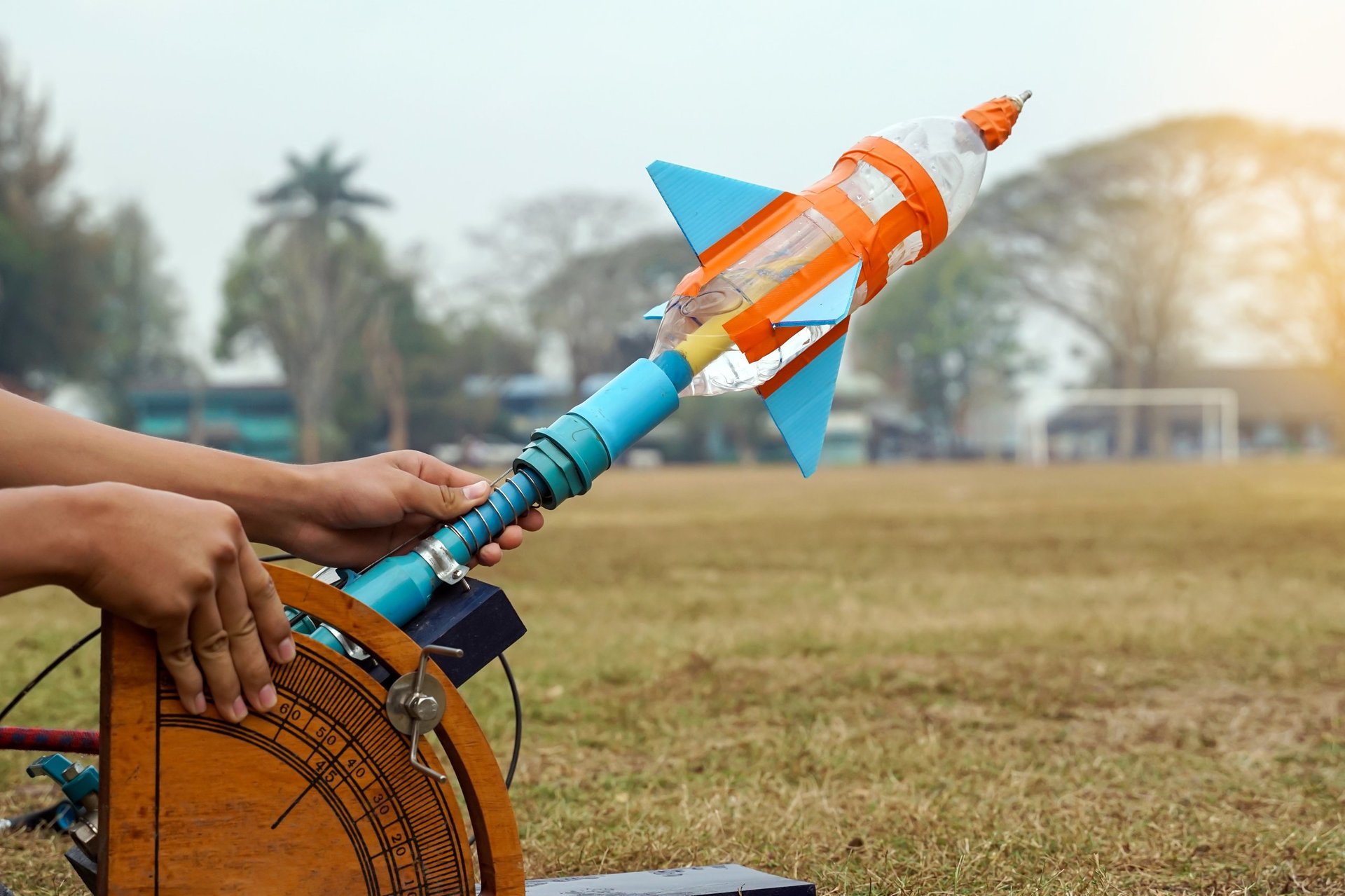
Turn Chemistry
Into Lift-Off!
The Chemical Reaction
Discover how simple household ingredients create powerful propulsion
Complete Balanced Equation
HC2H3O2+NaHCO3→NaC2H3O2+H2O+CO2
Try It Yourself - Fill in the Coefficients!
Answer: All coefficients are 1! This is already a balanced equation.
Chemical Reaction
When acetic acid reacts with baking soda to create CO₂ gas, H₂O and NaC₂H₃O₂. The carbon dioxide gas forms very fast, creating the energy needed for the rocket launch.
Pressure Buildup
Inside the sealed bottle the CO₂ gas is trapped. The pressure inside the bottle becomes more and more as more gas is formed.
Rocket Launch
Eventually the pressure is too much for the cap to hold and the gas rushes out downwards, pushing the bottle upwards like a rocket. This experiment is an example of the ideal gas law.
Reaction Products
Sodium Acetate
NaC₂H₃O₂
Water
H₂O
Carbon Dioxide
CO₂ (The Thrust!)
Optimal Mass Calculations
Finding the perfect balance of reactants for maximum rocket height
Baking Soda
White Vinegar
Molar Ratio Analysis
Step 1
(7)(1) = n(0.0821)(293) = 0.291
Step 2
Find molar mass of NaHCO₃ = 84g
0.291 mol CO₂/1 × 1 mol NaHCO₃/1 mol CO₂ × 84g NaHCO₃/1 = 24.4g baking soda
Step 3
2 = 0.291/x = 0.1455 or 145.5 mL
Launch Height Comparison
Optimal: 25g baking soda with 150ml vinegar = 10 ft average height
Why More Isn't Always Better
Too Much Baking Soda
- • Unreacted baking soda wastes a lot of mass
- • Adds to the weight of the whole rocket
- • Reduces the lifting power
- • Pressure loss means shorter burn time
The Sweet Spot
- • Complete reaction = CO₂ peak
- • Not a lot of extra mass
- • Best pressure increase rate
- • Creates the best lifting power for our rocket to soar
Rocket Launch Gallery
Witness the excitement of our bottle rocket experiments
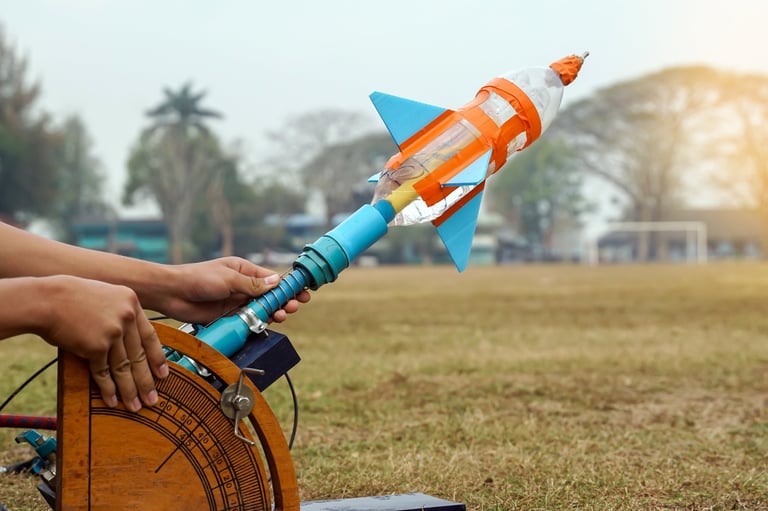
Launch Day!
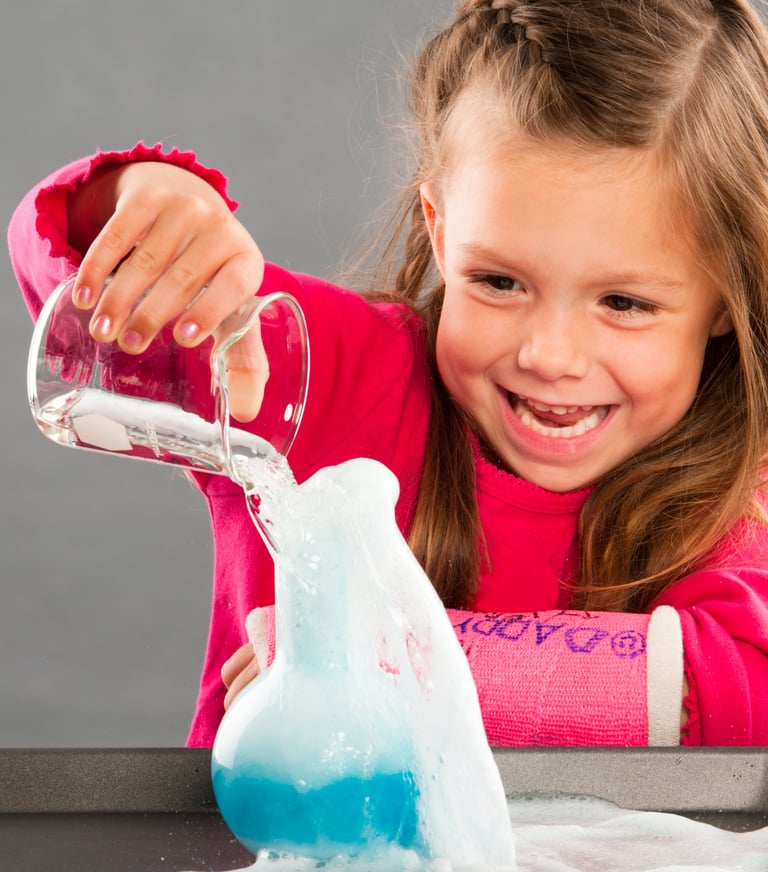
The Fizz
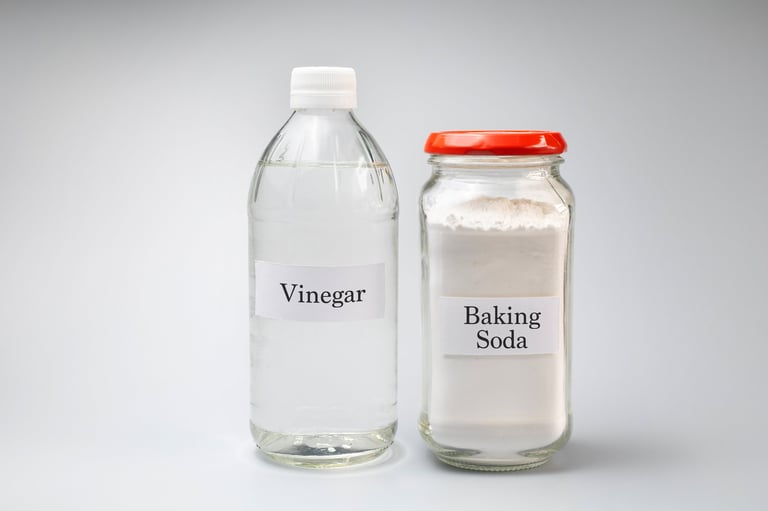
Science Setup
Safety Guidelines
Important safety guidelines for all rocket experiments
Safety Goggles and Latex Gloves
Always protect your eyes and hands with proper safety goggles and latex gloves during mixing and launch.
Outdoor Launch
Only do the launch in an open outdoor area away from buildings, objects, and people.
Safe Distance
Maintain at least 10 feet distance from the rocket during countdown.
Adult Supervision
Always have adult supervision present during the entire experiment.
Stable Setup
Make sure the rocket is properly secured on a steady launch pad.
Critical Safety Warning
Never point the rocket at anything but the sky. Always launch away from anyone watching and in a safe place. The rocket can travel pretty fast so be sure you are using it with proper use.
Results & Data
Reviewing our data and major findings
Experiment Timeline
Key Findings & Learnings
Chemistry in Action
We saw how gas formed in acid base reactions can be used for energy to move the rocket.
Mass Matters
More reactant means more weight with no related increase in power, lowering its performance.
Stoichiometry Works
The 1:1 molar ratio gave us predictable results, validating theoretical chemistry.
Safety is Critical
The right safety steps made the experiment go smoothly without any accidents.
Team Collaboration
Every member worked together to create the most efficient rocket that would soar through the sky!
Launch Countdown
Feel the excitement of a rocket launch with our interactive countdown timer!
Press start to begin the countdown. Watch as pressure builds and the rocket launches!
FizzLift Rockets proves that chemistry is more than equations on paper, its energy, motion and creativity taking off for flight.
Launch Test
Peak Height
Reaction Rate Efficiency
Our experiment used chemistry and hands on learning to make memorable rocket launches that show true science. Each step, from calculating molar ratios to measuring thrust, shows the connection between practice in the classroom and a lot more.